In linear algebra, a Householder transformation (also known as a Householder reflection or elementary reflector) is a linear transformation that describes a reflection about a plane or hyperplane containing the origin.
Where is a unit vector and is the identity matrix.
How does it work?
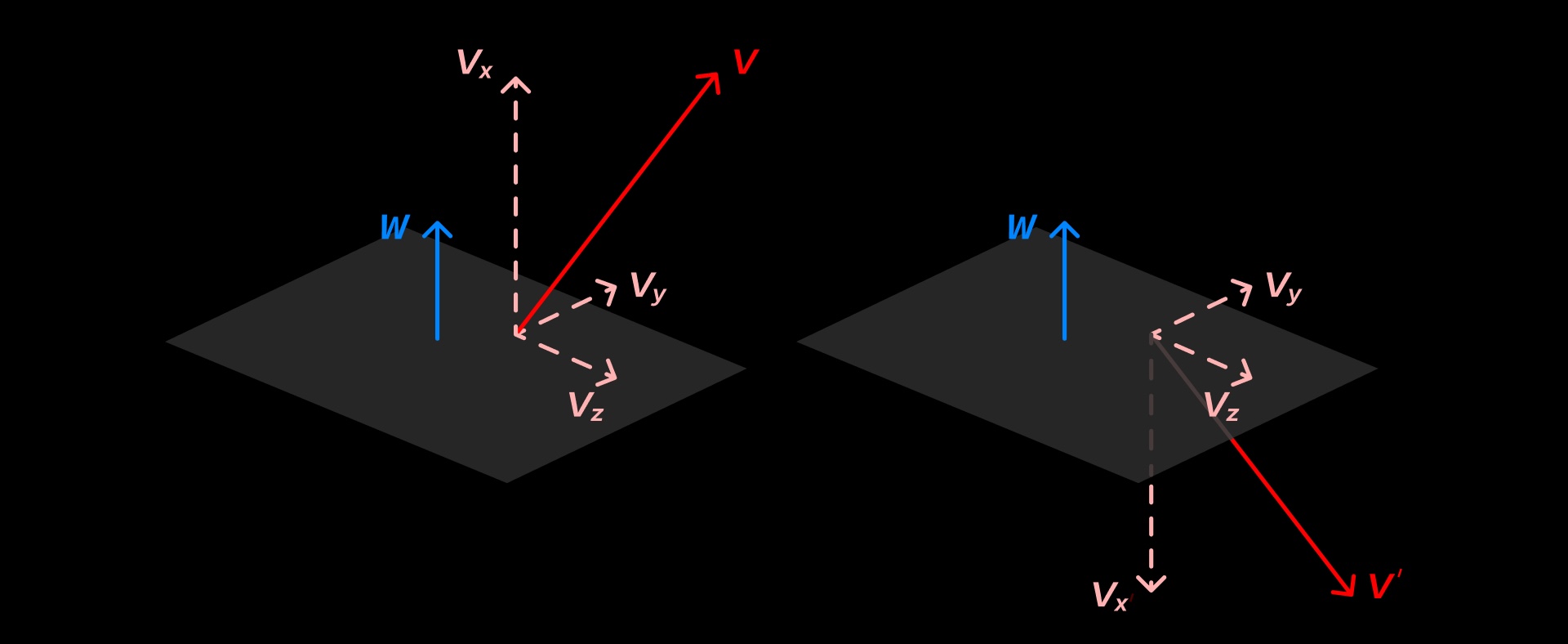
Let's take the 3-dimensional space as an example. As shown in the figure above, we think of as a normal vector of a plane. Suppose we have a given vector , we decompose onto a set of orthogonal basis , ensuring that . This decomposition meets:
Then, after the Householder transformation, will become:
Thus, is mirrored onto along the normal vector of .